US-27 South Lake Corridor
The 38-mile US-27 spine through south Lake County couples four municipalities — Clermont, Minneola, Groveland, Leesburg — into a single growth organism that is now splitting in two. The same aquifer constrains them. Overlapping developer rosters (LPG, GT USA, Pulte, Richland Communities) move capital between them. SJRWMD water permits, the Live Local Act, and SB 180's August 2024 retroactive ceiling apply to all four uniformly. Inside that shared regime, two regimes are forming. The Southern Transformation runs on institutional capital — $316 million in single-year Wellness Way land deals, the $2 billion Olympus master-planned development, the $300 million Hills Town Center. The Northern Resistance runs on denial blocs and identity preservation — Leesburg's nine peripheral denials, Groveland's Eco-Agrarian code. Hancock Road and Hartwood Marsh Road widening (spring 2026 construction) will eventually stitch the two halves into one accelerated corridor.
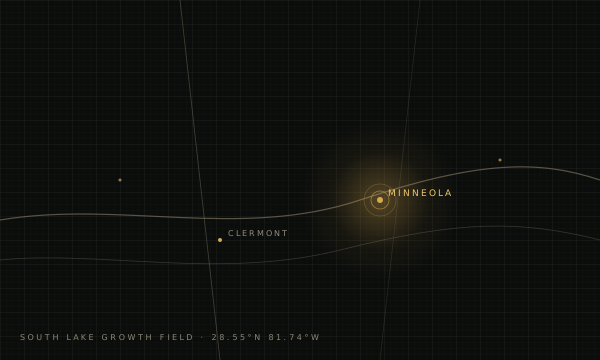
Cross-municipal economic-topology view. Reads decisions across jurisdiction boundaries — shared aquifer, overlapping developer rosters, common state regulatory regime.
Corridor Thesis
The 38-mile US-27 spine through south Lake County couples four municipalities — Clermont, Minneola, Groveland, Leesburg — into a single growth organism that is now splitting in two. The same aquifer constrains them. Overlapping developer rosters (LPG, GT USA, Pulte, Richland Communities) move capital between them. SJRWMD water permits, the Live Local Act, and SB 180's August 2024 retroactive ceiling apply to all four uniformly. Inside that shared regime, two regimes are forming. The Southern Transformation runs on institutional capital — $316 million in single-year Wellness Way land deals, the $2 billion Olympus master-planned development, the $300 million Hills Town Center. The Northern Resistance runs on denial blocs and identity preservation — Leesburg's nine peripheral denials, Groveland's Eco-Agrarian code. Hancock Road and Hartwood Marsh Road widening (spring 2026 construction) will eventually stitch the two halves into one accelerated corridor.
Pressure Map
Activity concentrates at six corridor pressure points across the cross-municipal field.
- Wellness Way / Hartwood Marsh growth front (south Clermont) — the corridor's institutional-capital core. $316M in 2024 land deals; $2B Olympus master-planned development; 19,000 residential units in the build-out plan. GT USA's $166.5M Panther Run acquisition (2,400 acres, 3,000+ homes); Pulte's $90M / 840 acres; Richland's $60M Hickory Groves (406 acres). The 2022 Wellness Way Design Standards govern; SB 180-grandfathered.
- Hancock Road / CR-561A residential spine (Minneola into Wellness Way) — the physical stitch between the southern transformation and the rest of the corridor. Del Webb 846-unit community; Sugarloaf Mountain PUD 2,555 approved units; Pointe Grande 300 apartments (Lake County's first Live Local project).
- Hills Town Center / Minneola downtown — $300M mixed-use destination. Crooked Can's 42,950 sq ft destination brewery and City Center Market food hall (opened July 15, 2026). AdventHealth 80-bed hospital with 24-hour ER (December 2025).
- Hooks Street / US-27 commercial frontage (Clermont) — 2024 self-storage saturation peak (~350,000 sq ft approved in one year); 2025 pivot to hotel, office, daycare. Clermont West Phase 2 revised (storage removed, 250-room hotel + daycare, 5-2 approval). LPG two-phase storage plays (combined 150,000 sf) entitled before the regulatory window narrowed.
- Leesburg southern boundary (CR-48, CR-33) — denial pressure front. Nine peripheral residential projects denied in 2024–2025 — Denham Village (~1,500 units), Oak Ridge (~894 units), Banning 5 (294 homes), Leatherleaf (283 units), Lake Bright/Brighurst, Cronin-Dewey Robbins, Venice at Lake Harris, Lake Margaretta Estates, Dominium Apartments — every one staff-recommended for approval. ~6,500-home approved-but-unbuilt south Leesburg pipeline (Whispering Hills 2,300+; Bar Key 1,800; Mar-Jo Pines 402; Brightleaf 253) continues to build.
- Cherry Lake Village / Groveland southern edge — eco-agrarian code battleground. August 2025 commercial-to-residential conversion denied 6-0 after resident William Rutter testified to the commercial expectations set at purchase. Form-based code recognized by Congress for New Urbanism; SB 180 caps strictness until October 2027.
Municipal Crosscurrents
The four cities' decisions interact through six named cross-currents.
- Leesburg-to-Minneola pressure migration. Leesburg's denial bloc (Marshall, Carter, Bowersox, Robertson) holds the rural edge; the development pressure does not vanish — it migrates south toward Minneola and Clermont where the political climate is more accommodating.
- Cherry Lake → Oak Valley traffic spillover. Groveland's Cherry Lake subdivision generates cut-through traffic into Minneola's Oak Valley neighborhood. Commissioner Nathan Focht in late 2024: the Minneola–Groveland coordination attempt "did not go as planned."
- SJRWMD water-permit cascade. The St. Johns River Water Management District tells Minneola to restrict irrigation as a Consumptive Use Permit condition; Clermont faces the same mandate months later. Both cities have adopted irrigation ordinances and smart-controller mandates inside two years.
- LPG developer cross-city pivot. Rural-edge Leesburg denials pushed LPG to downtown Leesburg (lakefront 278-unit project approved 7-0); same firm, same corridor, different city, different code regime, four months apart.
- Live Local defensive-architecture spread. Minneola adopts defensive ordinance (March 2024) restricting Live Local eligibility to industrial and general business zones. Clermont lowers maximum density caps to shrink the ceiling Live Local projects can reference. Leesburg, addressing the Act only in December 2024, remains most exposed (30 units per acre maximum density ceiling).
- Crooked Can / Hills Town Center demonstration effect. Minneola's $400M+ institutional bet (Hills Town Center + AdventHealth hospital + Crooked Can brewery) becomes the regional reference for whether small-city mixed-use destinations can validate at 20,000-population scale.
Infrastructure Unlocks
Eight named infrastructure surfaces shape the corridor's growth rate.
- Hartwood Marsh Road widening — county-funded since 2007; $12M county loan announced late 2025; construction begins spring 2026. The eastern Clermont and Wellness Way capacity unlock.
- Hancock Road / CR-561A — residential spine extending from Minneola south into Wellness Way. The literal physical stitch between the corridor's two halves.
- Florida's Turnpike widening — from 4 lanes to 8 lanes. Corridor-scale highway capacity expansion.
- SR-516 with wireless EV charging — pending. Emerging-format infrastructure surface.
- Minneola wastewater treatment capacity — Minneola City Manager has warned that the 1.0 MGD plant is approaching 2008-era limits. The de facto growth ceiling for the northern half.
- SJRWMD Consumptive Use Permit conditions — the binding water authority across the corridor. Minneola has adopted two irrigation ordinances in two years; Clermont cut its annual water budget by 20% (35 to 28 inches).
- Olympus health campus — $100M Healthcare Trust of America investment; 175,000 sq ft of medical offices; dual NHL-sized ice center; 2,800 direct jobs at full build-out; $1.5B taxable value.
- AdventHealth Minneola hospital — 80 beds, 24-hour emergency room, opened December 2025.
Why It Matters
Four cities, four entitlement environments. The cross-city arbitrage map is the corridor's leading indicator.
Wellness Way (Clermont) carries the cleanest 18-month entitlement runway for residential and design-standard commercial. Form-based codes 2022-grandfathered; McKinnon Groves 660 homes (3-2 comp + 4-1 rezoning); Olympus signage 4-1; Lennar Swap 7-0. The runway is open under the existing PUD framework.
Leesburg's rural edge is closed for new peripheral residential. Nine denials in two years; the Marshall-Carter-Bowersox-Robertson bloc holds. The same commission unanimously approves downtown density: LPG's lakefront 278-unit project sailed through 7-0; the Lee School redevelopment (apartments in a historic building) passed 5-2. Target downtown or the lakefront; the rural edge is politically closed.
Minneola approves but rewrites. Citrus Grove (1,000-condominium new urbanist mega-project) was approved with seventeen stipulations — height limits in feet not floors, condominium count capped, water facility acreage tripled, communication towers removed, industrial uses restricted to "light." Sugarloaf Mountain PUD 2,555 units approved. Pointe Grande Phase 2 reduced 768 → 178 units through community pressure. Approve-with-friction, not denial. High revision overhead.
Groveland is mid-build identity transition. Eco-Agrarian code work constrained by SB 180 until October 2027; conventional subdivisions still flowing. Cherry Lake Village commercial-to-residential conversion denied 6-0 (August 2025) is the gateway-protection signal.
Cross-city arbitrage surfaces:
- Self-storage closed in Clermont (4-2, January 2025); the LPG Hooks Street two-phase storage play (combined 150,000 sf) ran entitlements through before the window narrowed. Storage applications will look for landing in Leesburg, Groveland, or Minneola — but the gas-station-bellwether reads (corridor-wide unanimous denials) signal the storage gate is closing across all four.
- Live Local Act exposure varies sharply: Leesburg most exposed; Clermont most defended; Minneola moderately defended. For a 40%-affordable Live Local play, Leesburg is the open city.
- Gas station entitlement is cooked corridor-wide. Both Minneola (Hancock/CR-561A, 4-0) and Clermont (Wellness Ridge gateway, 0-5) unanimously denied 2025 gas station applications. Read the bellwether before filing.
The corridor's basis-point edge sits at three signals the comparables-driven market has not yet priced.
Olympus is the corridor's anchor capital event. $2B master-planned development with $100M Healthcare Trust of America health campus expresses a thesis on the southern half at institutional scale. The signage approval (4-1, October 2025) moves Olympus from planning to physical identity. Track ground-breaking and tenant absorption as the southern thesis's price-signal velocity.
Wellness Way assets carry a regulatory moat. The 2022 Design Standards predate SB 180's August 2024 retroactive line; legally grandfathered through October 2027 and beyond. The 7-Eleven denial (0-5, October 2025) demonstrated enforcement teeth. The asymmetry caps speculative supply along the corridor's gateway and favors capital underwriting to the design-standard product.
Minneola's institutional bet is the corridor's first small-city demonstration test. $400M+ of capital ($300M Hills Town Center + 80-bed AdventHealth hospital + Crooked Can's 42,950 sq ft destination brewery) at a 20,000-population scale exceeds population-multiplier underwriting; the bet is on demonstration-effect. Forward indicator: Crooked Can opening attendance (opened July 15, 2026). If the small-city destination model validates, the corridor's investment thesis revalues.
Leesburg pipeline reweighting — taxable property value soared from $1.2B to $3.2B; $750M added in a single year per City Manager Al Minner. The denial bloc has gated new peripheral additions; existing approved pipeline (Whispering Hills 2,300+, Bar Key 1,800, Mar-Jo Pines 402, Brightleaf 253) continues to build. Capital is positioned in projects entitled before the bloc consolidated.
Cross-city triangulation — the corridor's most readable signal. Clermont's self-storage restriction (C-2 to M-1, 4-2 January 2025, sustained 5-2 through April 2026) is a scarcity-premium event for existing storage in Clermont AND a forward indicator for similar moves in Groveland and Minneola where commercial-corridor saturation pressure is identical. Reweight away from greenfield storage exposure on US-27; reweight toward existing-asset scarcity-premium positions.
The corridor fracture is the broker's map. Clermont + Minneola carry the strongest parcel narratives — Wellness Way's SB 180-grandfathered design standards, $2B Olympus institutional capital, the $300M Hills Town Center with its July 15, 2026 anchor open. For those parcels: the form-based moat and the anchor activation timeline. Leesburg's downtown lakefront and Groveland's Cherry Lake commercial frontage carry distinct narratives — commission-approved density in the urban core; identity-defended commercial precedent on the rural edge. The storage-pivot argument runs all four cities: Clermont moved storage to M-1 (4-2, January 2025); gas stations denied unanimously at Wellness Ridge and Hancock Road. Existing assets gain the argument; new supply cannot enter.
Each city offers a distinct corridor narrative the broker can construct.
For a Wellness Way parcel: the corridor's most durable narrative. 2022 design standards SB 180-grandfathered. Olympus $2B + McKinnon Groves 660 homes + Lennar Swap 699 set the institutional-capital floor. The 7-Eleven denial proved enforcement. Resale story: the only south Lake corridor where form-based codes compounded into protected character.
For a Minneola Hills Town Center adjacency: a destination-brewery and 80-bed hospital narrative. The corridor's first small-city institutional-scale destination bet ($300M + AdventHealth). Resale: pre-anchor basis with post-destination unlock; the Crooked Can opening (July 15, 2026) is the trigger event. Kevin Skorman, the developer, calls it "the premier community gathering place in Lake County."
For a Leesburg downtown / lakefront parcel: the corridor's restraint-redirect narrative. The same Planning Commission denying nine peripheral projects approves downtown 7-0 (LPG 278 units). Downtown Mixed-Use district expanded to 131.5 acres. The argument for a client: Leesburg is restraining the rural edge and channeling density into the urban core; downtown is the city's growth conduit.
For a Groveland Eco-Agrarian frontage: an early-positioning narrative. Form-based code being built; SB 180 ceiling lifts October 2027; $154.2M utility investment shows long-term commitment. The honest argument: the regulatory framework is being built; the build-out window is post-2027. For a client willing to underwrite the regulatory transition, the basis is set before the framework activates.
For a US-27 commercial pad anywhere on the corridor: the storage-pivot narrative. Self-storage saturation peaked in 2024; Clermont's January 2025 vote moved storage to M-1; the corridor is diversifying away from storage toward hotel, office, daycare. Pads that play in the new format will trade.
Cross-city arbitrage to construct: a storage operator's existing assets in Clermont gain regulatory scarcity; new storage entitlement is now Leesburg / Groveland / Minneola, but the gas-station-bellwether reads suggest the storage gate is closing across the four cities. A residential builder's pre-existing-pipeline positions in Leesburg and Wellness Way carry construction-window opportunity as Hancock Road and Hartwood Marsh widening firm.
SB 180 exposure varies sharply by city. Clermont's January 2025 self-storage relocation from C-2 to M-1 (4-2, Bain and Hoisington opposing) is challengeable as a regulation "more restrictive or burdensome" on development under the August 2024 retroactive effective date — with automatic preliminary injunctions and attorney fee recovery for prevailing plaintiffs. Groveland's still-developing CDC V5 form-based code is exposed if adopted within the SB 180 window. Leesburg never built defensive codes after August 2024; least exposed because nothing to challenge. Minneola's defensive Live Local ordinance (March 2024) is grandfathered — pre-dates the SB 180 retroactive line.
Pointe Grande in Minneola (300 apartments on Sullivan Road; targeting households earning $50,000–$85,000) is Lake County's first Live Local Act project. The 19-month community-pressure reduction (768 → 178 units in Phase 2) is the corridor's first practical demonstration that civic engagement can reshape Live Local outcomes the law tries to preempt. Citation precedent for Live Local counsel statewide.
Denial-pattern legal exposure (Leesburg). After the November 2025 Dominium denial, Vice-Chair Sanders asked City Attorney whether the Commission could be sued for denying code-compliant projects. Planning Director Dan Miller publicly distanced from the denial pattern, noting he would have been "distraught" if the board had denied a flex-space project. Lake 100, a business group, has recommended replacing the Planning Commission with a professional Magistrate system; the commissioners responded with "strong concern about their continued existence." The four-member denial bloc and the staff-recommendation-vs-board-disposition record across nine projects forms the evidentiary base for the corridor's most likely 12-month litigation event.
Form-based code precedent (Clermont). The October 2025 V3 Capital 7-Eleven denial (0-5 at Wellness Ridge gateway, staff aligned) is the cleanest precedent the corridor has produced for enforcing form-based design standards as substantive regulatory tools. The Wellness Way Design Standards (adopted 2022) are SB 180-grandfathered; the denial reasoning ("the Wellness Way Neighborhood District envisions coffee shops and yoga studios, not gas stations") survives review. Citation-grade for design-standard enforcement counsel.
Quasi-judicial procedural professionalization (Clermont). City Attorney Waugh conducted Sunshine Law and quasi-judicial training March 2025; ex parte disclosure rules advanced August 2025. The procedural baseline is rising; pre-meeting communications are increasingly relevant.
Quorum-fragility precedent. Groveland's three resignations and chronic absenteeism in two years; Clermont's September 2024 Family Christian Center 2-2 outcome with three commissioners absent. Outcomes change with attendance; the procedural lesson holds across the corridor.
Healthcare and adjacent operations: corridor-positive across both halves. Olympus's $100M health campus (175,000 sq ft of medical offices, 2,800 direct jobs at full build-out) plus AdventHealth's 80-bed Minneola hospital (late 2025 opening, 24-hour ER) plus a 126,000-population baseline growing at rates that make Leesburg one of the fastest-growing cities in America creates a healthcare-adjacent operational substrate. Site selection for medical office, urgent care, behavioral health, ambulatory surgery: all four cities have ground.
Retail expansion: corridor-pivoted from storage saturation toward hotel, office, daycare. Clermont's 2024 self-storage saturation peak (~350,000 sq ft approved in one year) gave way to 2025 diversification — Clermont West Phase 2 revised (storage removed, 250-room hotel and daycare retained, 5-2 approval); Bloxam Offices 48,500 sf flex (6-0); Sprouts at Hammock Ridge Crossing (5-2). For a retail or hotel operator, the corridor's frontage parcels are repositioning toward your category.
Brewery, experiential, mixed-use destination: Minneola is the corridor reference. Crooked Can's 42,950 sq ft headquarters (four times their Winter Garden taproom) plus an 11-concept food hall plus a farmer's market plus a 2-acre outdoor event space anchors the $300M Hills Town Center. Opened July 15, 2026. For an experiential operator considering small-city Florida expansion, the destination-anchor model is being tested in real time at small-city scale.
Industrial, flex, light manufacturing: Minneola has growing capacity. The defensive Live Local ordinance restricts Live Local eligibility to industrial and general business zones, meaning industrial zoning has been protected from residential-density encroachment. Leesburg's flex-space approvals pass without opposition.
Brand prototype operators face one corridor-uniform constraint: gas stations are cooked. Both Minneola (Hancock/CR-561A, 4-0 denial) and Clermont (Wellness Ridge gateway, 0-5 denial) unanimously denied 2025 gas station applications. Fuel operations near established residential will not entitle.
Infrastructure timing read: Hartwood Marsh Road widening (spring 2026 construction, eastern Clermont and Wellness Way capacity becomes operational 2027–2028); Minneola wastewater plant approaching 2008-era limits (sewer-availability check before site selection in the northern half); Turnpike widening 4 → 8 lanes (corridor-scale logistics capacity unlock); SR-516 with wireless EV charging (emerging-format surface for EV-fleet and charging-network operators positioning Florida as a testbed).
The highway is becoming two highways. Driving south on US-27 from Leesburg toward Clermont, the landscape shifts from Villages-adjacent through Sugarloaf Mountain ridgeline citrus country into the commercial intensity of Clermont's frontage. Five hotels stand within a mile of each other on Clermont's US-27. Self-storage facilities occupy land that was orange groves a decade ago. The southern half is transforming faster than the northern half.
Construction starts on Hartwood Marsh Road in spring 2026. The county-funded widening begins after years of deferral. Construction trucks, lane closures, and traffic disruption come first; once complete, the road's capacity opens. Until then, every new home in eastern Clermont (McKinnon Groves' 660 homes, Ivey Ridge's 155 homes, Wellness Way build-out) and Minneola's growing northern half funnels onto roads above capacity.
Crooked Can brewery opened in Minneola on July 15, 2026. The 42,950 sq ft destination brewery and food hall is the largest single attraction the small-city cluster has produced — eleven named food concepts, a farmer's market, a stage for live entertainment. For residents along the corridor, the destination is a 30-minute drive from any of the four cities.
AdventHealth's 80-bed hospital opened in Minneola in December 2025 with a 24-hour emergency room. For residents in the northern half who currently drive further for emergency care, this changes the calculus.
Landscaping and water rules are tightening across the corridor. The St. Johns River Water Management District has mandated irrigation reductions in Minneola (twice in two years) and Clermont (a 20% water budget cut, from 35 to 28 inches). Smart controllers are required. New homes in Clermont can have sod on no more than 25% of the yard (down from 60%). These rules will reach Leesburg and Groveland too — the water district sets corridor-wide policy.
The neighborhood-meeting playbook works across the corridor. In Clermont, Waterbrooke residents' 2024 protest that promised "Shops" had become self-storage preceded the January 2025 commission vote moving self-storage from C-2 to M-1. In Minneola, the Del Webb community's PowerPoint with crime statistics and a 3,086 daily-trip projection denied a gas station 4-0. In Leesburg, sustained community pressure shaped the Planning Commission's denial pattern. In Groveland, residents like William Rutter testified to defend the commercial promises made when they purchased homes. The pattern: residents who attend reshape what gets built.
The corridor is splitting in two governance regimes. Southern half (Clermont + Minneola): institutional-grade capital + form-based codes + DPZ CoDesign engagement + defensive Live Local architecture + the Hills Town Center mixed-use bet. Northern half (Leesburg + Groveland): identity preservation + denial-bloc governance (Leesburg) + eco-agrarian code (Groveland) + structural state-local tension. The two halves are coordinating less than the shared infrastructure and aquifer require.
Cross-municipal coordination is currently weak. Commissioner Nathan Focht's late-2024 statement that Minneola's attempt to coordinate with Groveland on Cherry Lake → Oak Valley cut-through traffic "did not go as planned" names the structural gap. Yet the systems coupling is total — same aquifer, same school district, same developer rosters, same state regulatory regimes.
Fiscal sustainability diverges sharply. Leesburg's taxable property value soared from $1.2B to $3.2B; $750M added in a single year. City Manager Al Minner: "It's Leesburg's time in the crosshairs." Clermont's annexation pipeline brought $10.1M in November 2025 impact fees alone. Minneola is betting $400M+ institutional capital ($300M Hills Town Center + $80-bed hospital + AdventHealth investment) on demonstration-effect at a 20,000-population scale. Groveland's $154.2M utility investment is the corridor's strongest infrastructure-commitment signal in the northern half.
State-local tension applies to all four uniformly. SB 180 caps all four cities' regulatory authority on anything adopted after August 2024 until October 2027. The Live Local Act preempts local zoning for 40%-affordable housing projects — the corridor's first project (Pointe Grande in Minneola) demonstrated that civic engagement can reshape outcomes the law tries to preempt. SJRWMD's Consumptive Use Permit conditions are accepted across the corridor because the alternative is losing water service. These regimes apply uniformly; the cities' responses diverge.
Governance capacity varies sharply. Clermont's professionalization push (City Attorney Waugh's Sunshine Law and quasi-judicial training; ex parte disclosure protocols; DPZ CoDesign comprehensive plan engagement; Strong Towns Clermont under Commissioner May) creates the highest governance baseline in the corridor. Minneola's two-person planning staff manages mega-projects with help from super-participant residents (Kevin Carey's unpaid engineering review of fire-truck turning radii, stormwater capacity, signal spacing, lighting calculations; David Yeager's pavement and landscaping reviews) — fragile but effective. Groveland's three resignations and chronic absenteeism is the corridor's lowest governance baseline. Leesburg's denial-bloc-vs-staff tension creates legal exposure.
The infrastructure-inheritance pattern compounds with annexation. Cross-municipal coordination on Wellness Way build-out (Clermont's southern boundary is Lake County unincorporated) and on the US-27 corridor's traffic load (shared across all four cities) is the regional fiscal-sustainability test. Coordinate now or watch four divergent code regimes consolidate when SB 180 sunsets.
Every cognitive position on the corridor agrees on the cross-cutting truth. The corridor is one organism — coupled by the highway, the aquifer, the developer roster, and the state regulatory regimes — and the organism is splitting into two regimes. The Southern Transformation (Clermont + Minneola) and the Northern Resistance (Leesburg + Groveland) are real divergences, not artifacts of the lens model. Every cognitive position reads the split.
The dialectics are also real. They are not artifacts of the lens model; they are how the same evidence resolves differently to people with different stakes.
The investor reads the southern transformation as capital-thesis confirmation — Olympus's $2B, McKinnon Groves' 660 homes, the Wellness Way design-standard moat. The civic leader reads the same transformation as fiscal-sustainability strain — the annexation impact-fee revenues against the infrastructure-inheritance costs from projects designed under Lake County standards. Same evidence, opposite resolution.
The developer reads Leesburg's denial bloc as 18-month entitlement closure on the rural edge. The resident in south Leesburg reads the same denial bloc as community-protection working as intended. Same nine peripheral denials, opposite valence.
The attorney reads SB 180 as a litigation surface — the post-August-2024 ordinances challengeable across all four cities, with automatic preliminary injunctions and attorney fee recovery for prevailing plaintiffs. The civic leader reads the same SB 180 as a structural state-local fragility threatening the corridor's regulatory experimentation. The developer reads it as a closing entitlement window with a date certain — October 2027 — to plan filings against. Three lenses, three readings, one statute.
The business operator reads gas-station unanimity (denials in Minneola and Clermont) as a brand-prototype constraint to design around. The resident reads the same unanimity as the neighborhood-protection bellwether. The broker reads it as the corridor's storage-pivot indicator. Same denial pattern, three operational consequences.
The investor reads Crooked Can's July 15, 2026 opening as the destination-anchor demonstration test — does $400M+ of institutional capital validate at 20,000-population scale? The resident reads it as a place to take the family. The civic leader reads it as the corridor's first small-city institutional-scale destination bet that, if it works, revalues the regional fiscal-sustainability framing. Same beer hall, three different surfaces.
The deeper dialectic the corridor itself organizes: the Southern Transformation runs on grandfathered regulatory authority and institutional capital; the Northern Resistance runs on democratic action and identity preservation. The corridor is testing whether these two regimes can co-exist along one spine when the connective infrastructure (Hartwood Marsh, Hancock Road, Turnpike widening) starts pushing the southern transformation north. Four cities, one spine, one aquifer, one developer network, one state regulatory regime. The split is real; the coupling is total; the connective infrastructure is firming. Both halves keep building. The framework that reads them now sees the organism whole.
Watch Next
- Spring 2026 Hartwood Marsh Road construction start. When ground breaks, the 18-month entitlement window for eastern Clermont opens. Watch ground-breaking on McKinnon Groves and Olympus tenant-pad commitments as forward indicators. Confirms: the southern entitlement runway accelerates. Refutes: construction schedule slips the unlock by 12+ months.
- Leesburg denial-pattern legal challenge. Sanders' attorney inquiry; Lake 100's magistrate-replacement proposal; the staff-recommendation-vs-disposition record across nine projects. A successful code-compliant project denial challenge reopens the rural edge for new peripheral residential. Watch for the first filing.
- Minneola wastewater capacity announcement. If the 1.0 MGD plant hits its limit, the de facto moratorium freezes the northern half. Watch the Minneola City Manager's capacity reports for hard-ceiling signal.
- October 2027 SB 180 sunset (or earlier repeal). Senate has passed repeal as of February 2026; House has not moved. After: a burst of restrictive code-writing across all four cities. The entitlement environment for code-after-2024 projects shifts. Plan filings against the calendar.
- Hartwood Marsh Road construction milestones (spring 2026 onward). The disruption window is underwriting-relevant; the post-widening capacity unlock is the basis-point thesis for the southern half. Eastern Clermont and Wellness Way absorption rates re-rate when the road opens.
- Crooked Can opening (opened July 15, 2026, Minneola). Validates or refutes the $400M+ institutional bet on small-city town-center viability. Attendance and food-hall tenant absorption are the small-city-as-destination test. Confirms: the corridor's investment thesis revalues for similar mid-sized adjacencies. Refutes: the demonstration-effect framing collapses.
- Olympus tenant absorption and ground-breaking cadence. The signage approval (4-1, October 2025) moved Olympus from planning to physical identity. The $2B mega-development's velocity is the southern thesis's price-signal velocity.
- Minneola wastewater capacity ceiling. If the 1.0 MGD plant hits its wall, scarcity premium for already-entitled units in the northern half compounds. The supply gate closes.
Three corridor events move the broker's argument simultaneously. First: Hartwood Marsh Road breaks ground spring 2026 — eastern Clermont and Wellness Way parcels that read as pre-widening basis become post-widening unlock as construction is ground-visible. Second: Crooked Can opened July 15, 2026 — the Minneola adjacency story converts from destination-planned to destination-validated; tenant performance and attendance are the signals that harden the Hills Town Center pitch. Third: the first legal challenge to Leesburg's denial pattern. A successful code-compliant rural-edge denial challenge resets the northern corridor's parcel arguments. The geographic sort is the operating map until the first challenge lands.
- Per-corridor decision flow on the next two months' agendas across all four cities. Each disposition adds to the narrative the broker constructs for clients. Watch Clermont February-March 2026; Leesburg's response to the Dominium aftermath; Minneola's Citrus Grove and Sugarloaf phases; Groveland's Cherry Lake successor applications.
- Crooked Can opening attendance and tenant performance (opened July 15, 2026). Becomes the tangible client-conversation reference for Minneola adjacency parcels and a test of the destination-anchor argument for similar small-city plays.
- Hartwood Marsh Road construction visible progress. A tangible client-conversation reference for eastern Clermont parcels — the deferred unlock becoming legible on the ground.
- Cherry Lake Village commercial pivot attempts (post-August 2025 6-0 denial). The argument for Groveland commercial frontage rests on whether the eco-agrarian code holds when SB 180 lifts October 2027. A subsequent denial confirms the gateway-protection signal; an approval reopens the commercial-conversion narrative.
- First SB 180 challenge filing against any of the four cities' post-August-2024 ordinances. Clermont's January 2025 self-storage relocation (4-2) is the most exposed; Groveland's developing CDC V5 form-based code is exposed if adopted within the SB 180 window. Watch the Lake County circuit court docket.
- First Leesburg denial-pattern legal challenge. Sanders' attorney inquiry, Lake 100's magistrate proposal, the staff-recommendation-vs-disposition record across nine projects together form the predicate. The corridor's most likely 12-month litigation event.
- October 2027 SB 180 sunset (or earlier repeal). Position counsel posture for both the still-frozen and the post-sunset regulatory environments. Senate has passed repeal as of February 2026; House timing governs the active window.
- Procedural-formalization deltas in Minneola and Groveland. Clermont's professionalization push (Sunshine Law training, ex parte disclosure protocols) is the corridor's reference; whether neighbors adopt similar protocols is precedent-relevant for quasi-judicial proceeding standards across the corridor.
- Crooked Can opening (opened July 15, 2026, Minneola). Validates or refutes the destination-anchor model for small-city Florida expansion. The brewery + food hall + farmer's market + outdoor event space combined-use template is the corridor's first test of small-city experiential operations at this scale.
- Hartwood Marsh Road construction milestones. Operational-readiness signal for eastern Clermont and Wellness Way sites. 2027–2028 site activation timing depends on the schedule.
- Minneola wastewater plant capacity announcements. Binding constraint for new development requiring sewer connection. Sewer-availability check before any northern-half site selection.
- DPZ CoDesign Clermont downtown form-based code recommendations (12-month horizon). The downtown entitlement framework reshapes; site-selection assumptions for downtown footprints should anticipate the form-based regime.
- Spring 2026 Hartwood Marsh Road construction start. Construction disruption window precedes capacity relief. Plan commute alternatives for eastern Clermont and Minneola residents.
- Crooked Can opening (opened July 15, 2026, Minneola). Destination-scale traffic patterns reshape local routes around Hills Town Center. Eleven-concept food hall, farmer's market, and outdoor event space draw from all four cities.
- Next Live Local Act application in any of the four cities. The law preempts denial; the community-pressure playbook (Pointe Grande Phase 2 reduced 768 → 178 units through 19 months of sustained engagement) is the corridor's response template.
- Water-budget enforcement progression. SJRWMD mandates spread across all four cities; smart controllers required; sod limits at 25% in new Clermont homes. Expect similar restrictions reaching Leesburg and Groveland.
- Live-streamed P&Z meetings across all four boards. Attendance still affects outcomes — Waterbrooke, Del Webb, William Rutter, the Leesburg denial-bloc backers, and Pointe Grande Phase 2 are all on the record. Meeting times: Leesburg Thursdays 4:30 PM; Clermont, Minneola, Groveland evenings.
- October 2027 SB 180 sunset (or earlier repeal). The corridor's regulatory experimentation runs on grandfathered authority until then. After: a burst of code-writing across all four cities. Coordinate now or watch four divergent code regimes consolidate.
- Cross-municipal coordination on Hartwood Marsh Road and Hancock Road traffic management. The widening reshapes growth on both sides of the Clermont–Lake County boundary; coordination with Lake County unincorporated is the southern-corridor test.
- Crooked Can / Hills Town Center demonstration-effect (opened July 15, 2026). If Minneola's $400M+ destination bet validates, regional fiscal-sustainability framing for small-city institutional capital shifts. Other south Lake municipalities can study the architecture.
- Leesburg legal-exposure crystallization. A successful denial-pattern challenge would reshape the corridor's regulatory-leverage architecture and the political viability of denial-bloc governance corridor-wide.
- DPZ CoDesign Clermont comprehensive plan deliverables (12-month horizon). The framework becomes the regional reference; Minneola, Groveland, Mascotte, and Montverde can adopt or diverge. The corridor's coordination-or-divergence question gets its first answer here.
Five compound indicators move multiple lenses simultaneously. These are the corridor's cross-cutting forward signals.
- Hartwood Marsh Road construction milestones (spring 2026 onward). Moves the developer (eastern Clermont entitlement window opens), the investor (basis-point thesis on disruption-window underwriting), the resident (construction disruption then capacity relief), the business operator (operational-readiness for eastern corridor sites). One signal, four lenses.
- Crooked Can opening (July 15, 2026, Minneola). Moves the investor (destination-anchor demonstration test), the broker (Minneola adjacency narrative trigger), the business operator (small-city Florida destination model validation), the civic leader (regional fiscal-sustainability framing for small-city institutional capital). One opening, four lenses.
- October 2027 SB 180 sunset (or earlier repeal). Moves the developer (entitlement-window closure date certain), the attorney (litigation-surface window closure plus post-sunset code burst), the civic leader (corridor's regulatory-experimentation window closes; coordinated code-writing or four divergent regimes consolidate), the investor (regulatory-tailwind window closure). One statutory event, four lenses, four cities.
- Minneola wastewater capacity ceiling (1.0 MGD plant, 2008-era limits). Moves the developer (de facto moratorium for the northern half), the investor (scarcity premium for already-entitled units), the business operator (sewer-availability check before northern-half site selection), the civic leader (corridor's binding growth ceiling). One infrastructure constraint, four lenses.
- First Leesburg denial-pattern legal challenge. Moves the developer (rural-edge reopening surface), the attorney (corridor's most likely 12-month litigation event), the civic leader (governance-capacity question on the Commission's continued existence), the broker (rural-edge narrative reset). One legal event, four lenses.
The compound signals share a structure: each is corridor-scale, each moves four lenses, each lands within an 18-month horizon, and each lands across multiple cities. Watching them together is watching the corridor's organism evolve.
Source Trail
- Master regional synthesis:
_regional/_synthesis.md(NLAA, Jan 2024 – Mar 2026, 77 P&Z meetings analyzed across Clermont, Leesburg, Minneola, Groveland) - Supporting investigative trajectories:
_regional/corridors/us-27-corridor-intelligence.md;_regional/themes/governance-evolution.md;_regional/themes/state-local-regulatory-tension.md;_regional/themes/deep-signals.md - City syntheses (constituent places):
clermont/_synthesis.md;leesburg/_synthesis.md;minneola/_synthesis.md;groveland/_synthesis.md - Lake County: Hartwood Marsh Expansion (clickorlando.com, December 2025) — county widening funded; spring 2026 construction start
- Crooked Can Minneola Groundbreaking (growthspotter.com, April 2025) — destination brewery; the groundbreaking-era April 2026 target (venue opened July 15, 2026)
- Wellness Way Land Rush (jaredjones.com, November 2024) — $316M in single-year land deals; GT USA Panther Run; Pulte; Richland
- Olympus $100M Health Campus (lakeandsumterstyle.com) — Healthcare Trust of America partnership; 175,000 sq ft medical offices; 2,800 jobs at full build-out
- SB 180 Analysis (Bilzin Sumberg, September 2025) — retroactive August 2024 effective date; October 2027 sunset; preliminary injunction and attorney fee recovery for prevailing plaintiffs
- SB 180 Repeal Window Closing (WGCU, February 2026) — Senate passed repeal; House has not moved
- Live Local Act 2025 Updates (Holland & Knight) — preemption of local zoning for 40%-affordable housing
- Pointe Grande Minneola (growthspotter.com, July 2025) — Lake County's first Live Local project
- Leesburg and The Villages Growth (clickorlando.com, October 2024) — "Leesburg's time in the crosshairs"; $1.2B → $3.2B taxable property value
- Groveland Form-Based Code (CNU Florida) — Congress for New Urbanism recognition; SB 180 constraint
- Clermont Comprehensive Plan Update — DPZ CoDesign engagement; 1,500+ community survey responses
- 1000 Friends of Florida: SB 180 — restoration of community planning; preemption critique
Constituent Places
- Clermont, Florida — the corridor's institutional-capital concentration point. ~49,000 population. Wellness Way + Hartwood Marsh + Hooks Street + Downtown + SR-50 commercial frontage. Highest governance baseline in the corridor.
- Leesburg, Florida — the corridor's denial-bloc node. ~38,000 population. Downtown Mixed-Use 131.5 acres; nine peripheral denials; ~6,500-home approved-but-unbuilt south Leesburg pipeline; first measurable corridor-litigation surface.
- Minneola, Florida — the corridor's small-city-destination test. ~20,000 population, 42% growth since 2020. Hills Town Center + Crooked Can + AdventHealth + Pointe Grande + Sugarloaf Mountain PUD. Two-person planning staff; super-participant residents (Kevin Carey, David Yeager).
- Groveland, Florida — the corridor's identity-code battleground. ~25,000 population. Eco-Agrarian code; Cherry Lake Village; $154.2M utility investment; SB 180 ceiling on form-based-code strictness until October 2027.
- Davenport, Florida — the corridor's I-4 / US-27 interchange anchor (north Polk). ~13,000 population. High-volume voluntary annexation cleanup engine (15+ paired LU+Zoning ordinances Sep–Dec 2025); Pulte Homes Sand & Silica CDD (1,070 units, 287.90 ac); Planning Commission and City Commission share members.
- Haines City, Florida — the central Polk corridor city. ~32,000 population. Hwy 544 / Hughes Road / Scenic Highway 17 residential RPUD spine (1,200+ approved lots in active build-out); 2-3 year construction-commencement reverter clause as signature regulatory tool; Anderson dissent on Marion Groves (Oct 23, 2025) is the corpus's first Polk-side dissent vote.
- Lake Wales, Florida — the corridor's southern Polk anchor. ~17,000 population. 6-0 Masterpiece Road denial (Jul 22, 2025) is the corpus's first Polk-side denial-bloc evidence; Sec. 23-443 form-based-justification standard is the closest Polk analog to Wellness Way Design Standards; SEUP-driven commercial-corridor specialization (six SEUPs in seven months).
The Polk Extension — Quiet Revolution Propagation Test
The Quiet Revolution Highway 27 thesis was first crystallized for the four Lake County cities (Clermont, Minneola, Leesburg, Groveland) in March 2026. The thesis identified a coupled growth organism splitting into two regimes: a Southern Transformation (Clermont + Minneola, institutional capital + form-based codes) and a Northern Resistance (Leesburg + Groveland, denial-bloc filtering + identity preservation). The thesis explicitly stopped at the Lake/Polk line.
The May 2026 MISSION-10 expansion harvested 19 standardized Planning Commission / Planning & Zoning Board documents across Davenport, Haines City, and Lake Wales — the three Polk cities along US-27 south of the Lake/Polk line. The expansion tested whether the Quiet Revolution thesis propagates southward as a structural pattern or fragments at the county boundary into distinct Polk dynamics.
Propagation Findings
The Quiet Revolution thesis CONFIRMED southward — with REVISIONS noted.
The institutional-capital + form-based-codes + denial-bloc-filtering trinity propagates partially-to-substantially across all three Polk cities, with Lake Wales demonstrating the strongest propagation and Davenport demonstrating the weakest. The corridor extends as a single growth organism through Polk, with each Polk city occupying a distinct functional position analogous to (but not identical to) its Lake County counterpart.
Institutional capital — CONFIRMED propagation. Pulte Homes' Sand & Silica Community Development District (1,070 units, 287.90 acres) at Davenport's Olsen Road corridor is the corpus's first Polk-side institutional-developer signal. Pulte is the same firm that paid $90 million for 840 acres in Wellness Way (Clermont). Two parallel Pulte beachheads now bracket the entire 70-mile US-27 South Lake / North Polk segment. The capital roster crosses the county line. Hunt Brothers Industrial in Lake Wales (agricultural-to-industrial conversion of citrus-grove land) extends the institutional-capital pattern to a distinct Polk variant — agricultural-to-industrial rather than master-planned-mixed-use, with explicit jobs-creation framing ("I can't grow oranges anymore so I want to grow jobs").
Form-based codes — PARTIAL propagation. Lake Wales' Sec. 23-443 Land Development Regulation requires the Planning Board to make a substantive judgment about whether reductions in setback and lot size are justified by housing variety — the closest Polk analog to Clermont's Wellness Way Design Standards as a substantive regulatory tool. The standard is less mature than Wellness Way (which is a complete form-based code with detailed building placement, street design, and pedestrian orientation requirements) but stronger than anything in Davenport or Haines City. Haines City's 2-year and 3-year construction-commencement reverter clauses on Ford Family Trust and Marion Groves RPUDs are a different regulatory architecture — cycle-forcing post-approval pressure rather than form-based pre-approval substantive standards — but functionally similar in their substantive-regulatory-tool character.
Denial-bloc filtering — CONFIRMED propagation, most strongly in Lake Wales. The 6-0 Masterpiece Road denial (Lake Wales, July 22, 2025) is the corpus's first Polk-side denial-bloc evidence — a 148-home rural-arterial single family development denied unanimously after sustained public mobilization on rural-character grounds. The pattern matches Leesburg's denial-bloc architecture nearly exactly. Haines City's Anderson dissent on Marion Groves (October 23, 2025) is a less-consolidated denial-formation signal — case-specific rather than philosophy-stable, but the procedural infrastructure (Chair McLean's June 9 dissent-reasoning rule) had been deliberately prepared. Davenport shows no denial-formation evidence in the corpus — the shared Planning Commission / City Commission membership likely structurally precludes denial-bloc emergence.
SB 180 surface — CONFIRMED propagation. All three Polk cities surfaced SB 180 explicitly on the record. Lake Wales engaged earliest and most explicitly (July 22, 2025 — discussion with City Attorney Chuck Galloway). Davenport's Mayor Summerlin questioned CFRPC consultant Marisa Barmby on the "more restrictive or burdensome" language at the November 17 EAR comp plan amendment. Haines City's LDR Chapter 5 text amendment (June 9, 2025) lands inside the SB 180 retroactive ceiling. The corridor-wide SB 180 cliff applies uniformly to the seven-city US-27 corridor.
Voluntary annexation jurisdictional tool — CONFIRMED propagation, most strongly in Davenport. Davenport's voluntary annexation cleanup engine ran 15+ paired LU+Zoning ordinances in four months — the corpus's highest residential-parcel-count density. The mechanism mirrors Clermont's Kohl's-style single-large-parcel annexation but operates at much higher per-meeting density on individual residential parcels. Haines City's Prince & Sons (IND→CG, 10.13 ac) and Ford Family Trust (78-lot RPUD, 19.66 ac) follow the Groveland three-ordinance template. Lake Wales' Hunt Brothers Industrial annexation (4-2) follows the same template for agricultural-to-industrial conversion.
Three-ordinance industrial annexation playbook — CONFIRMED propagation, in Polk-variant form. Groveland's Lake County industrial annexation pattern (Gadson Street + Langley Industrial Park, identical procedural template six months apart) propagates to Polk in two distinct variants:
- Davenport's residential variant: paired LU+Zoning amendments at high parcel-count density.
- Lake Wales' agricultural-to-industrial variant: Hunt Brothers Industrial annexation (4-2 split) converts citrus-grove land to City I-1 Industrial.
- Haines City's commercial variant: Prince & Sons IND→CG converts existing-commercial parcels to City Commercial General.
The bellwether gas station pattern does NOT cleanly propagate. Lake County's unanimous gas-station denials (Minneola Hancock/CR-561A 4-0 deny; Clermont Wellness Ridge gateway 0-5 deny) do not appear in the Polk corpus. Lake Wales' Citgo Taco Truck SEUP (gas-station-with-mobile-food) was approved — the inverse pattern. The bellwether-gas-station pattern is a Lake County-specific denial-bloc indicator, not a corridor-wide pattern.
The food-truck CUP cadence pattern does NOT cleanly propagate. Clermont's three-month food-truck CUP cadence (Crab Cakes / Wahlburgers / Mayamero) that forced a text amendment is not the Polk regulatory mechanism. Lake Wales handles food trucks via SEUP (Citgo, Taco Riendo) with case-by-case term-length calibration rather than CUP-cadence-to-text-amendment escalation. The Lake Wales SEUP regulatory regime is more flexible per-case but does not produce the cascading text-amendment dynamic.
The Refined Corridor Thesis
The 70-mile US-27 corridor from Davenport (north Polk) to Leesburg (north Lake County) is one growth organism — coupled by the highway, by overlapping institutional-developer rosters (Pulte, Lennar, GT USA), by SB 180 statewide preemption, by the Florida Live Local Act's defensive ordinance challenge, and by the structural growth pressure from both the Orlando metro and the Tampa-Lakeland metro converging on south Lake / north Polk.
The organism is splitting into multiple regimes. The Southern Transformation continues to be most fully expressed in Clermont and Minneola (institutional master-planned mixed-use, form-based codes, Wellness Way). The Northern Resistance continues in Leesburg and Groveland (denial-bloc filtering, identity preservation, eco-agrarian code). The Polk Extension adds three regional positions:
- Davenport as the High-Volume Annexation Engine — the corridor's most efficient jurisdictional-consolidation mechanism, structurally compressed by shared PC + CC membership, with institutional capital arriving via Pulte's Sand & Silica.
- Haines City as the Mid-Scale RPUD Pipeline + Emerging Dissent — the corridor's most-active mid-scale residential pipeline (Hughes Road / Hwy 544 / Scenic Highway 17 with 1,200+ approved lots), with construction-commencement reverter clauses as substantive regulatory tools and case-specific dissent emerging.
- Lake Wales as the Southern-Polk Form-Based Edge — the corridor's most-developed Polk-side form-based-code analog (Sec. 23-443 substantive justification), the corpus's first Polk-side 6-0 unanimous denial precedent (Masterpiece Road), and the cycle's most-explicit board-level SB 180 engagement.
The connective infrastructure between Lake County and Polk is both physical (US-27 itself, plus the I-4 interchange at Davenport) and institutional (overlapping developer rosters, statewide regulatory regimes, SB 180 sunset June 2026 affecting all seven cities simultaneously). The corridor's growth organism does not stop at the county line — it extends through Polk's three US-27 cities with regulatory tools and board posture that mirror Lake County's cities in functional position even if not in specific regulatory form.
The Quiet Revolution thesis is CONFIRMED for the Polk extension. The corridor is a single growth organism. The propagation is asymmetric — Lake Wales most strongly, Haines City partially, Davenport selectively — but the fundamental pattern recognition holds.
Connected Signals
- Parent region: South Lake Florida — the multi-corridor area containing US-27 South Lake plus the Wellness Way internal corridor and the SR-50 commercial corridor.
- Neighboring corridor: Wellness Way Corridor — the 15,500-acre master-planned area southeast of Clermont; institutional-capital concentration that anchors the Southern Transformation half.
- Related brief: The Quiet Revolution on Highway 27 — the named-pattern essay drawing on the same source synthesis; the editorial framing of the corridor's four-city governance reorientation.
- Cross-corridor named patterns affecting US-27 South Lake:
- The Self-Storage Canary — Clermont's commercial-pressure indicator; corridor-wide propagation watch (Leesburg, Groveland, Minneola).
- The Six-Month Board Flip — Clermont's Krzyminski → Bain transition; cross-corridor portability question (whether Minneola or Groveland Boards undergo similar reorientation).
- The SB 180 Cliff — corridor-wide retroactive ceiling on post-August-2024 codes; sunset October 2027.
- The Annexation Cascade — Clermont's growth mechanism; corridor-wide pattern of municipal-boundary expansion.
- The Workforce-Housing Vacuum — corridor-wide structural absence; Pointe Grande as Live Local first response.
- Related county: Lake County, Florida — the administrative parent; Hartwood Marsh Road widening is a county capital project; Lake County unincorporated is the corridor's southern boundary.
Cities along the corridor
Clermont
The most governance-sophisticated city in south Lake. Bain-era commission enforced the 2022 Wellness Way Design Standards in a 0-5 7-Eleven denial.
Minneola
Doesn't deny — rewrites. Citrus Grove approved with 17 stipulations. $300M Hills Town Center anchor Crooked Can opened July 15, 2026.
Groveland
Codifying eco-agrarian lifestyle into the zoning code. Cherry Lake Village 6-0 denial held the line. SB 180 caps strictness until October 2027.
Leesburg
Nine peripheral residential denials, every staff-recommended for approval. Same commission unanimously approves downtown lakefront density.
What is shaping the corridor
- Hartwood Marsh Road widening (spring 2026 construction start)
- Hancock Road / CR-561A residential spine extension
- Florida's Turnpike widening (4 lanes to 8 lanes)
- SJRWMD Consumptive Use Permit conditions (corridor-wide)
- SB 180 retroactive ceiling on post-August-2024 codes
- Live Local Act preemption (Pointe Grande precedent)
- Overlapping developer rosters (LPG, GT USA, Pulte, Richland Communities)
- Olympus $2 billion master-planned development
- Hills Town Center / Crooked Can $300M anchor
- Minneola wastewater capacity ceiling (1.0 MGD plant)
How the corridor moved
- AUG '25Eco-Agrarian Hold
- SEP '25Industrial Pivot
- OCT '25Form-Based Enforcement
- NOV '25$10M Annexation Tide
- DEC '25Hartwood Marsh Loan
- JAN '26Pipeline Construction
- FEB '26SB 180 Repeal Closing
- MAR '26Master Synthesis
- APR '26Spring Construction
- MAY '26June Target Named
- JUN '26Roster Completes
- JUL '26Crooked Can Opens
This corridor connects to
- Clermont, Florida
- Minneola, Florida
- Groveland, Florida
- Leesburg, Florida
- The June 2026 Window
- The Filter
- Annexation as Governance Tool
- Bloc Formation and Resolution
- The Citrus Grove Road / N. Hancock Road Cluster Forming in Real Time
- The Hancock Road Coupled System
- Lake County (Unincorporated)
- Clermont
- Clermont
- Minneola
- Minneola
- Lake Wales
- Master Regional Synthesis (Mar 2026)MAR 4, 2026
- US-27 Corridor Intelligence (Mar 2026)MAR 4, 2026
- Clermont 7-Eleven Denial (Oct 2025)OCT 7, 2025
- Pointe Grande Phase 2 ReductionJUL 8, 2025
- South Lake Corridor MapAPR 15, 2026
- The Quiet RevolutionAPR 15, 2026
What the field is watching
What the field is watching
The corridor reads what no single municipality can see alone.